
Celebrating Fiona Mackay
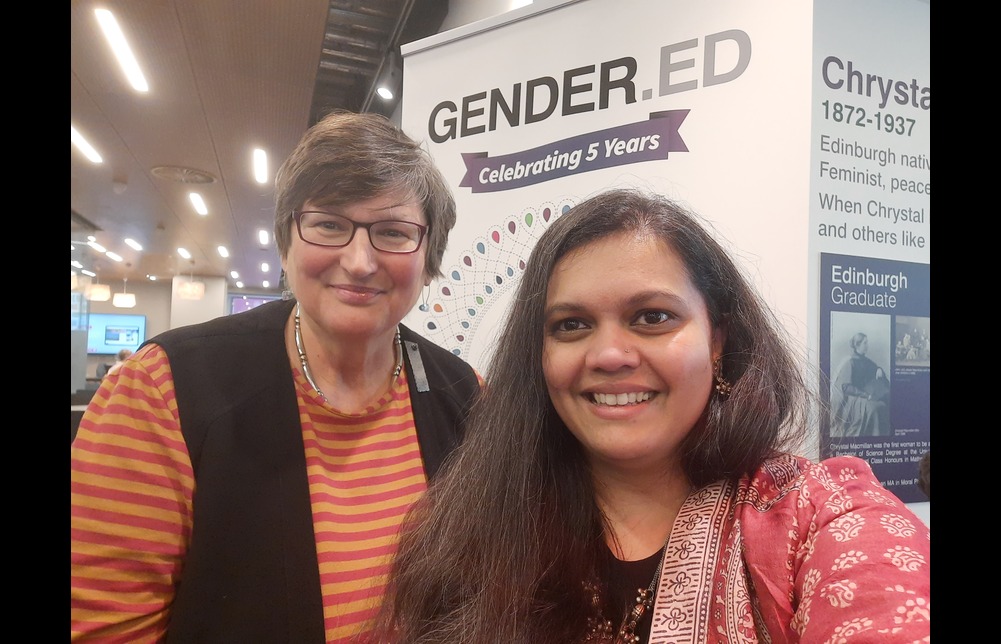
Fiona Mackay and Radhika Govinda at the GENDER.ED at five years reception in 2022. Photo by Radhika Govinda
Kicking off our dossier of blogs canvassing Fiona Mackay's immense contributions to gender studies at the University of Edinburgh and beyond - compiled on the occasion of her retirement a year ago - Radhika Govinda reflects on Fiona's feminist academic praxis and leadership.
Having spent ten years as a dedicated journalist, Fiona Mackay has often referred to herself as an "accidental academic", and what a happy accident it has been for us that she joined academia and stayed! Fiona came to pursue a PhD at the University of Edinburgh in 1991 and went on to make a career here, serving in a variety of roles, including Dean and Head of the School of Social and Political Science, and founding Director of GENDER.ED. Indeed, service and institutional leadership have been standout features of her impactful career.
Perhaps the most remarkable quality about Fiona’s leadership is her deep and unwavering commitment to structural and cultural change, to creating more inclusive professional cultures and institutions. Fiona has shown us by example what it means to be a feminist and a tempered radical in the academy, simultaneously negotiating institutional authority and oppositional knowledge, effecting change through small wins and authentic action over the long haul, and sometimes settling for the least worst outcome. As a firm believer in working for change from the inside, she has shown us what can be achieved by academic feminists as leaders, working with the grain of the institution, and being a critical friend of the institution when the situation demands.
Throughout her career, Fiona has made exceptional contributions to the discipline of political science, to its subfields of gender politics and territorial politics. Her path-defining work on political institutions and representation in Scottish and UK politics has revealed the crucial role that gender relations play in processes of institutional design, continuity, and change. She has also highlighted both the gendered potential for, and limits of institutional innovation and reform in the pursuit of gender equality. As founding co-Director of Feminism and Institutionalism International Network (FIIN), Fiona has been a key figure in pioneering the now-dominant methodological approach to studying political institutions in the sub-field of gender and politics. Beyond the academy, her research has had real-world impact on formal politics, including by contributing to the institutional design of the new Scottish Parliament. It is not surprising then that Fiona has been recognised through numerous disciplinary and institutional accolades, such as the European Consortium for Political Research (ECPR) Gender Politics Career Award in 2019.
A truly unique feature of Fiona’s academic praxis and leadership – of how she brings to bear the insights from her academic praxis on gender and politics to her leadership – is the incredibly enormous amount of time and effort she has invested and continues to invest in mentoring, coaching and sponsoring literally generations of academics, ranging from senior University leaders to early career fellows. Rare are those academics who consciously open up opportunities for others, who remember to leave the ladder down for others to climb after them, who actively clear the path for them and enable them to succeed, and rarer still are those who truly and genuinely celebrate the success of others as if it were their own, never once laying claim on it. Fiona belongs to that rarest of rare breed of academics who do both with unmatched humility.
I have been incredibly fortunate to experience this first hand. Words are insufficient to express my gratitude for you, Fiona, for your gracious mentorship and solidarity, and for the beautiful friendship that we have formed over the years. I can only hope to pay forward the lessons in slow and collaborative scholarship and in feminist solidarity and leadership that I have learnt from you. I am sure I am not alone in thinking this way. There are so many of us who have benefitted from your academic generosity, strategic guidance and mentorship. The love and respect you have earned, the myriad ways in which you have contributed to shaping careers, how we teach and what research we do, and how we lead with a human touch, your firm imprint on the School of Social and Political Science and its work culture, and your efforts to make the institution more inclusive have been truly inspiring. The ideas, interests, ethics, and principles that have animated your academic praxis will continue to animate ours for years to come. Fiona, you will be missed but never forgotten!