
Apathy by Design: Britain’s Arms Policy in Gaza
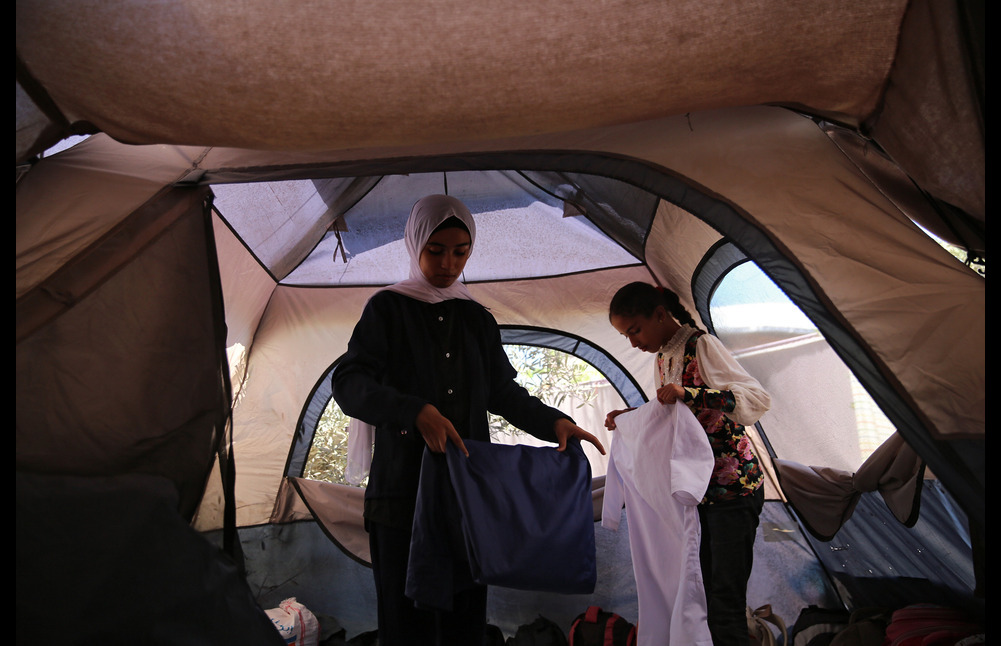
Two girls in Gaza fold clothes inside their family’s tent. Image credit: UN Women/Suleiman Hajji (via Flickr) https://www.flickr.com/photos/unwomenarabstates/54055820454/in/photostream/ https://creativecommons.org/licenses/by-nc-nd/2.0/deed.en
This is an excerpt from Jenny O'Donnell's exceptional essay offering a politically urgent and theoretically sophisticated intervention into debates surrounding the UK’s provision of arms to Israel, which won first place in the 2025-26 Yuan Changying prize.
Masculinised security logics define the strength of a country by their militant power, reducing the embodied impacts of warfare to strategy and logistics. The UK’s supposedly rational arms-export regime towards Israel, therefore, erases Palestinian people both in print and reality. The present genocide in the Gaza Strip (United Nations Human Rights Council, 2025) is characterised by decades of settler-colonial occupation dating from 1967, producing a situation of profoundly gendered Palestinian precarity (Alqaisiya and Perugini, 2024). Drawing on feminist international relations, decolonial theory, and scholarship on structural violence, I use the House of Commons briefing on Israeli arms trades (Brooke-Holland, 2025) to denaturalise legal thresholds and argue that they protect the interests of the disembodied white male subject at the centre of security, exposing how gender and coloniality shape which lives are grievable, and which harms remain illegible.
The Commons Briefing serves as an example of the West’s ability to use the softer power of policy to secure its dominance over the global majority. The UK refers to International Humanitarian Law (IHL) to judge the ethics of its arms-export licensing, allowing it to place itself among the most robust systems in the world (Brooke-Holland, 2025, pp.6-8). Following continuous review, the UK suspended a small number of licences to Israel in September 2024, while explicitly excluding categories of non-offensive equipment not currently used by the Israeli Defence Forces. Through a focus on their lack of contribution to physical violence, this policy grants the UK neutrality while making no attempt to prevent further violence, thereby naturalising the white Westerner as the global standard of moral warfare.
The language of the briefing may appear apolitical, yet it reflects state-centric understandings of harm that privilege legal thresholds over lived experience. Licensing is dependent on the risk of an item being used to seriously violate IHL (Brooke-Holland, 2025, p.6) – a threshold that renders some violence classifiable as lawful. Robinson (2021) describes this as a function of universal ethics, in which meaningful structural change is avoided through a focus on legal accordance. This leaves the militarised state – what Cohn (2012) describes as a continuation of the hierarchies that valorise masculinity, centring risk and force as key components of a nation’s strength – intact. Gender, then, is not an optional add-on to conflict analysis, but the architecture through which war becomes thinkable.
The operations of the state, viewed as a performance of gender, reveal Israel as a rational British ally. Connell (2004) links empire, dominance, and western civility through the notion of hegemonic masculinity. To appear politically competent, the UK aligns itself with military action, whose iconography casts men as leaders and women as in need of saving (Duncanson, 2020). Palestinians, on account of their racialisation, cannot meet this standard of masculinity, and the defence of their lives is coded instead as a threat to social order. Colonial constructions of race scaffold conflict intervention because they determine what is valued, and therefore what, or who, is worth protecting.
While the UK’s policy focuses on the detached technicalities of arms deployment, turning to its embodied impacts, particularly on women, highlights its complicity in sustaining gendered and colonial violence. Pratt et al. (2025) discuss how the bombing of Gaza functions as the symbolic and material demolition of the homemaker's domain, leaving care work simultaneously impossible and more important than ever. Palestinian women are forced to carry out the emotional and physical labour of survival within conditions designed to exhaust them. Lombard (2018) explains this as a form of structural violence – violence is not only direct physical harm but the maintenance of unequal power relations that devalue women, particularly evident during wartime when existing inequalities intensify. This is the silent work of the briefing: by not considering the impact arms have on feminised labour, it prevents effective social reproduction, making Palestinian futures more precarious. This evidences Cohn’s (2012) theory that everyday trivialisations of women and their labour blind policy to the forms of violence that target them.
The use of sexual violence as a tool of domination reveals how women’s bodies become a battleground for controlling the reproduction of ‘unfavourable’ groups or nations. Despite partial suspensions, the UK should be regarded as complicit in sustaining the militarised conditions that allow for Israel to control birthrates in Gaza through the bombing of hospitals, IVF clinics, and general deterioration of sanitary conditions that make both pregnancy and birth unsafe (Pratt et al., 2025). In fact, the policy justifies such violence as Israel’s “right to defend itself” (Brooke-Holland, 2025, pp. 6, 25, 26), positioning them as victims not perpetrators, gaining moral quality when placed against the “abhorrent ... ideology” (Brooke-Holland, 2025, p. 26) of Hamas. Existing distrust of black and brown bodies is mobilised to allow domination over them to appear as a natural extension of security measures.
Feminist care ethics reframes state security by centring vulnerability and interdependence over brute strength. True political care, Robinson (2021) explains, demands a complexity that accounts for the detailed topographies of real people and conflicting interests. This stands in opposition to military ‘solutions’ that value speed, force, and a detachment from embodied harm. This style of intervention firmly implements the political necessity of relationality, with implications for how femininity is positioned in sociopolitical spaces. The concept of neutrality completely collapses under this lens; Kevin Guyan’s (2022) critique of data neutrality emphasises that seemingly objective classifications are always formed in relation to a specific worldview. Acknowledging this would force policy such as the UK’s to recognise how positionality shapes perception of “risk” and “violence,” meaning all people must be considered with equal right to life. Care ethics, ultimately, reveal that genuine security depends not on arms transfers but on sustaining life, dignity, and accountability – values absent from current policy.
Through these routes, the supposed neutrality of the UK's foreign policy feeds into the hegemony of masculine dominance and simultaneously, upholds thresholds of harm that permit a base level of violence, and thereby enables the militarised state of Israel and the genocide it carries out.
Author biog:
At the time of writing this essay, Jenny was a second year MA Geography student at the University of Edinburgh. Inspired by her studies, this was written in the hopes of bringing together the course themes of gender and politics, with her geographical interest in the experience of space and positionality of representation.
References
Alqaisiya, W. & Perugini, N. (2024) ‘The Academic Question of Palestine,’ Middle East Critique, 33(3), pp.299-311. Available at: doi:10.1080/19436149.2024.2384009.
Brooke-Holland (2025) UK arms exports to Israel. (House of Commons Library briefing paper 09964. Available at: https://researchbriefings.files.parliament.uk/documents/CBP-9964/CBP-9964.pdf (Accessed: 1 December 2025)
Cohn, C. (2012) ‘Women and Wars: Toward a Conceptual Framework’ in C. Cohn & C.H. Enloe (eds.) Women and wars:contested histories, uncertain futures. Cambridge, Polity Press, pp.1-35.
Connell, R.W. (2004) ‘Globalisation, Imperialism and Masculinities’, in M.S. Kimmel, J.R. Hearn & R.W. Connell (eds), Handbook of Studies on Men and Masculinities. Thousand Oaks, SAGE Publications, Incorporated, pp.71-89.
Duncanson, C. (2020). ‘Masculinities, war and militarism.’ In: U. Mellstrom, L. Gottzen, & T. Shefer (eds.). Routledge International Handbook of Masculinity Studies. 1st edition. ABINGDON, Routledge. pp. 467-476. doi:10.4324/9781315165165-46.
Guyan, K. (2022) 'Introduction: Data and Difference' in Queer Data: Using Gender, Sex and Sexuality Data for Action. London: Bloomsbury Publishing Plc, pp. 1-24.
Pratt, N. et al. (2025), ‘Why Palestine is a feminist issue: a reckoning with Western feminism in a time of genocide’, International Feminist Journal of Politics, 27(1), p. 226-250.
Robinson, F. (2021) ‘Feminist foreign policy as ethical foreign policy? A care ethics perspective’, Journal of International Political Theory 17(1), pp.20-37.