
Performing Gender: Negotiating Identity, Power, and Belonging
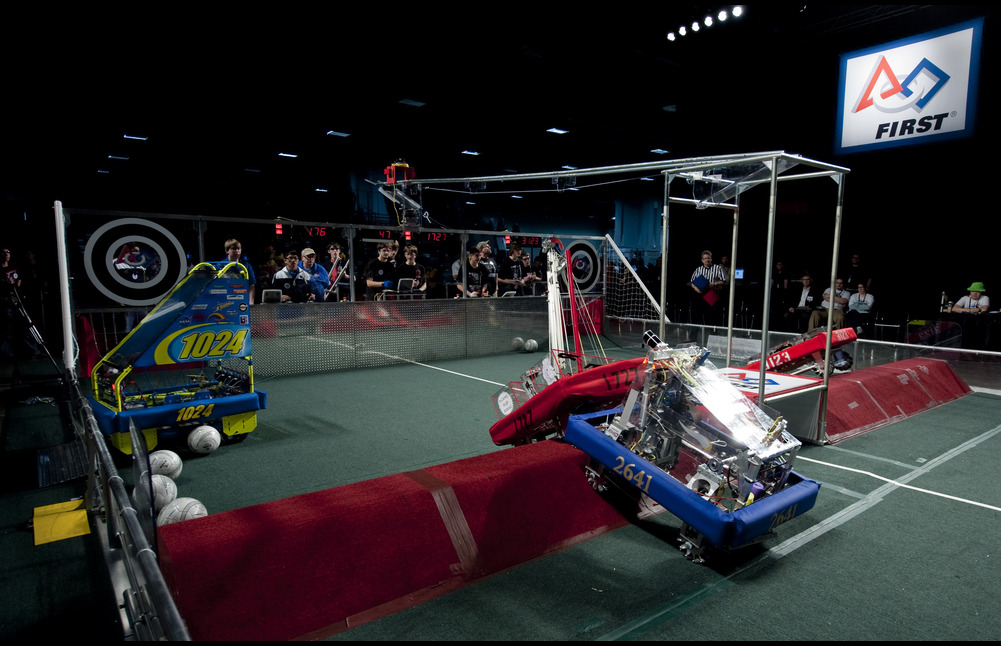
Robots vie for position during the second day of the First Robotics Competition, Saturday, March 6, 2010, in Washington. File:First Robotics Competition (830928).jpg - Wikimedia Commons
.jpg)
In this first of the 2025-26 Yuan Changying prize-nominated essays, Malina Chiddo reflects on her experiences in competitive high school robotics, asking: how does gender, race, and embodiment shape the ways we perform competence, navigate expectations, and negotiate belonging?
The robotics pit was loud enough to make conversation difficult. Pneumatics hissed, metal clanged, and mentors called out across the crowded space. Yet what I remember most from the final season on my high school robotics team is not the noise, but how differently I behaved there. I spoke more abruptly, lowered my voice, avoided behaviour that might seem “too feminine”, and made sure to demonstrate my technical knowledge. When male volunteers or members of other teams approached, I often stepped forward to answer questions before any male teammate could.
At one regional tournament, a judge asked who had milled the tiki-shaped turret on our robot. Before my teammate could answer, I immediately said, “I did,” and began explaining the design. At the time, my response felt instinctive. Looking back, I recognise that I was responding to more than a question about the robot. I was responding to an implicit expectation that, as a woman in robotics, I needed to prove that I belonged.
Candace West and Don Zimmerman’s concept of “doing gender” helps explain this experience. Rather than treating gender as something we simply possess, they describe it as something accomplished through social interaction and accountability (West and Zimmerman, 1987). In the robotics pit, I had learned to anticipate how I might be perceived and adjusted my behaviour accordingly. My posture, tone, confidence and willingness to speak first became ways of establishing technical credibility.
Judith Butler’s theory of gender performativity similarly helped me understand why this behaviour felt almost automatic. Gender, Butler argues, is produced through repeated acts shaped by social norms (Butler, 1988). I was not consciously deciding to “perform masculinity” every time I entered the pit. Instead, repeated experiences had taught me that assertiveness, decisiveness and technical confidence were valued there. These qualities were not inherently masculine, but they had become culturally associated with masculinity.
Raewyn Connell’s concept of hegemonic masculinity offers another way of understanding this dynamic. Certain forms of masculinity become culturally privileged, including traits such as authority, confidence and technical expertise (Connell and Pearse, 2014). In STEM, these qualities can carry particular authority. I found myself leaning into them because I knew, consciously or otherwise, that they could protect me from being underestimated. At the same time, this performance was not entirely negative. Robotics gave me genuine confidence in my technical abilities, and taking up space allowed me to recognise that I did belong. The difficulty was distinguishing between confidence that came from knowing I was capable and confidence I felt I had to perform in order to be believed.
Rosabeth Moss Kanter’s work on tokenism helps explain this pressure. In gender-skewed environments, people who are numerically underrepresented can experience heightened visibility and pressure to demonstrate their competence (Kanter, 1977). Robotics was not necessarily hostile to my presence, but I was conscious of entering a space where technical expertise was often presumed to belong to men. The face that I was also head of media, organisational and creative tasks reinforced a gendered division of labour in which technical work could appear more authoritative.
Crenshaw’s concept of intersectionality allows me to understand these experiences as more than separate effects of gender and race. My identity did not operate as a simple combination of categories; different aspects of who I was shaped how I anticipated being seen and evaluated (Crenshaw, no date). The meaning of my body changed depending on the context. In one setting, femininity and racialisation could make me feel vulnerable. In another, performing masculinity and technical authority could help me establish legitimacy.
This also made me question what belonging actually meant. Was I trying to become more like the people I expected to be accepted, or was I simply learning how to make my existing skills legible within a particular culture? The distinction matters. If competence has to be communicated through masculine-coded behaviour before it is recognized, then the problem is not an individual women’s lack of confidence. It is the environment that has taught her what confidence is supposed to look like.
The robotics pit therefore became more than a place where I built a robot. It became a space in which I learned how gender could be performed, negotiated and used as a strategy for belonging. What looked from the outside like confidence was sometimes a form of self-protection.
Recognising this has changed how I think about my own behaviour. I no longer want to view gender performance simply as something imposed upon me. I can also ask when I am choosing it, why I am choosing it, and whether I still need it. Sometimes navigating gender has meant making myself smaller. In the robotics pit, it sometimes meant making myself louder.
Author biog:
Malina Chiddo was born in Tokyo and raised on the Big Island of Hawai’i, and now studies Interdisciplinary Futures at the University of Edinburgh. Moving between Japan, Hawai’i and Scotland has shaped her interest in how culture, identity, place, and power influence the ways we understand one another and the world around us. Her interests include gender and race studies, climate justice, conservation, and cultural heritage, with a particular interest in ethical archaeology and anthropology. She also explores questions of identity and social structures through art and visual storytelling.
References
Butler, J. (1988) ‘Performative Acts and Gender Constitution: An Essay in Phenomenology and Feminist Theory’, Theatre Journal, 40(4), p. 519. Available at: https://doi.org/10.2307/3207893.
Connell, R.W. and Pearse, R. (2014) Gender: In World Perspective. Oxford, UNITED KINGDOM: Polity Press. Available at: http://ebookcentral.proquest.com/lib/ed/detail.action?docID=4029932 (Accessed: 13 October 2025).
Crenshaw, K. (no date) ‘Demarginalizing the Intersection of Race and Sex: A Black Feminist Critique of Antidiscrimination Doctrine, Feminist Theory and Antiracist Politics’.
Kanter, R.M. (1977) Men and women of the corporation. New York : Basic Books. Available at: http://archive.org/details/menwomenofcorpor00kant (Accessed: 24 November 2025).
Uchida, A. (1998) ‘The Orientalization of Asian women in America’, Women’s Studies International Forum, 21(2), pp. 161–174. Available at: https://doi.org/10.1016/S0277-5395(98)00004-1.
West, C. and Zimmerman, D.H. (1987) ‘Doing Gender’, Gender and Society, 1(2), pp. 125–151.