
Welcome back!
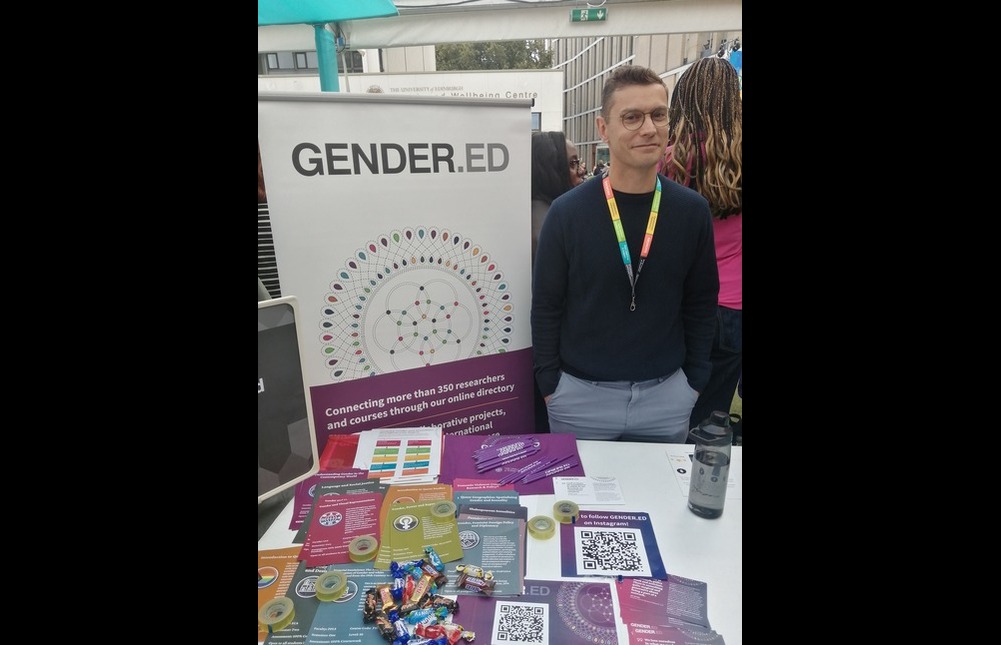
Associate Director Wannes Dupont staffing the GENDER.ED table at the EUSA societies fair on Tuesday. Photo by Kaveri Qureshi
As Welcome week draws to an end, Co-Director Kaveri Qureshi, and outgoing Summer Communications and Events Intern Jayni Makwana sit down to discuss what GENDER.ED got up to over the summer and what beckons in the new academic year.
Kaveri:
Welcome back to our GENDER.ED community, and welcome to new university members interested in gender and sexuality studies! This week I’ve been staffing the GENDER.ED table at the EUSA societies and student information fairs, along with the GENDER.ED core team plus much-appreciated efforts from steering group and student volunteers. Next to a table laden with course fliers and examples of gender-focused degree pathways, we were there to put the GENDER.ED directory on the radar for students as a one-stop catalogue for the gender and sexuality studies courses they could take from across the university, and for finding academic staff with resonant research interests, who they could and meet with during guidance and feedback hours.
We met with students from all over the world, undergraduates through to PhDs, some just visiting for one semester, about their academic interests in this area as well as their commitments deriving from how the personal is political. For me this is what GENDER.ED is all about: growing and enabling people’s passions and commitments, and making non-hierarchical connections across students and university staff.
On Wednesday, it was a particular pleasure to staff the GENDER.ED table next to student volunteer Lucy Wilson, whose prize-winning essay for our flagship course Introduction to Queer Studies we published in last year’s Queer Futures Prize blog series. If you explore the blog series I’m sure you, too, will be starstruck by the calibre of work undertaken on this course. The same is true of the Yuan Changying Prize-winning essays from our other flagship course Understanding Gender in the Contemporary World: abridged essays will be featured on the GENDER.ED blog next week, and editing them this summer has given me similar moments of feminist joy and delight, seeing how the course enabled first-semester first-year undergraduates to connect feminist thought to global geopolitical scales – as with Jenny O’Donnell’s upcoming essay – to the micro scale of embodied gender performances – as with Malina Chiddo’s.
Understanding Gender in the Contemporary World has now run for a full decade, and we’ll seek to highlight and explore this at our Welcome event this semester, alongside appreciating how the flagship courses serve as an anchor from which students can spiral through their respective degree programme curricula and deepen their knowledge of gender and sexuality studies through discipline-specific options courses. It feels urgent to be talking about our teaching provision at the current moment. While our university-wide courses are very large, some of the honours-level and postgraduate courses usually have smaller enrolment, because of how gender and sexuality studies are everywhere marginal and designated non-core by the disciplines around which taught programmes are organised. The university’s current wave of budget cuts, institutional restructuring and attempted efficiency savings have led to strict enrolment thresholds being applied in ways that threaten the capacity for students to avail joined-up curricula emphasising gender and sexuality studies. We have the same concerns for subjugated knowledges in race and coloniality, and related areas.
Jayni you were thrown into the midst of this during your summer internship, weren’t you, as we requested you to develop a social media campaign highlighting gender and sexuality studies teaching across the university and raise the profile among students?
Jayni:
That’s one of the main things I worked on this summer! I styled the campaign as about raising awareness of the various topics relating to gender and sexuality that students can explore across the university. Preparing the campaign, I enjoyed meeting and working with professors from a range of different departments, as well as developing my digital media skills which I have no doubt will be incredibly useful as I prepare to pursue a career in journalism after university.
As well as the social media work, through editing and preparing articles for the GENDER.ED blog, I learnt about a range of interesting and compelling topics. As well as developing my written communication skills, this also gave me the opportunity to attend multiple book launch events which I found particularly interesting and engaging.
As my internship was hosted by the Institute for the Advanced Studies in the Humanities (IASH), I was also involved in some exciting projects with them. I enjoyed curating, editing and designing the fourth text of the Dangerous Women series, which celebrated a decade since the launch of the project, as well as proof-reading poetry manuscripts for the second volume of Our Time Is A Garden and helping to host IASH's Book Festival Event in which Val McDermid and Jo Sharp discussed the Darien Scheme.
As a student, I really enjoyed this internship and I'm very grateful to have had the opportunity to work with GENDER.ED and IASH, understand better and contribute to what you do.
Kaveri:
The gratitude is all to you Jayni! Do take a peek at the campaign Jayni designed on our Instagram.