
A Framework for Understanding Reproductive Oppression in Kalaallit Nunaat (Greenland)
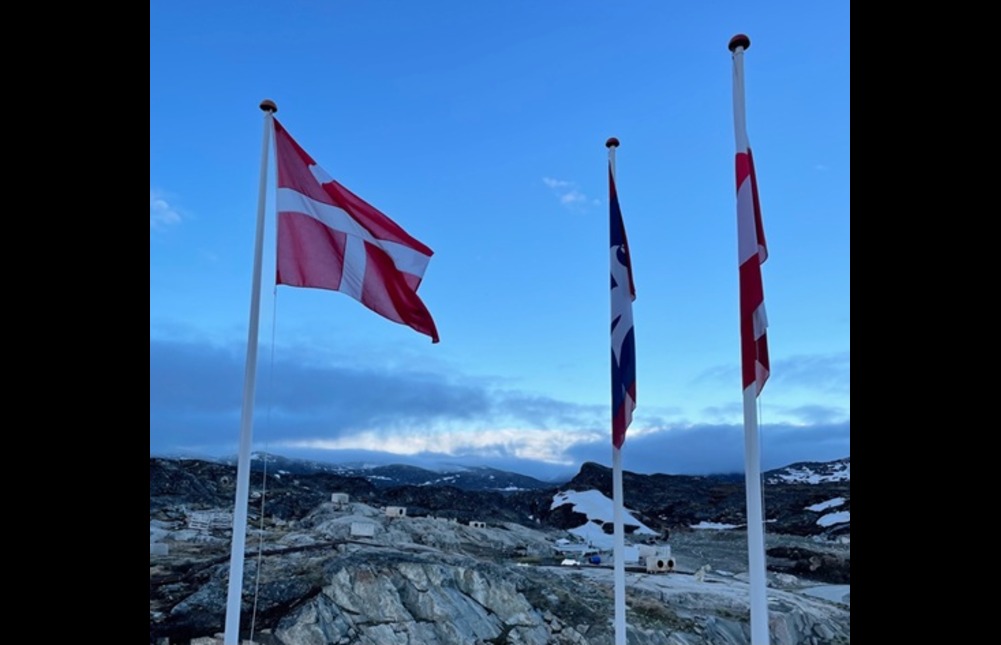
The Danish flag flying over a collection of sled dog kennels in Ilulissat, Kalaallit Nunaat.
Image: Eliza Kidd (2022)
Eliza Sinclair Kidd canvases her undergraduate dissertation on the Coil Campaign in Kalaallit Nunaat (Greenland), a large-scale, coercive contraceptive programme initiated by Denmark in the 1960s. Eliza explores the Coil Campaign through Foucauldian biopolitics and reproductive justice theories and outlines future research needed on reproductive violence in Kalaallit Nunaat.
In 2017, Naja Lyberth shared on Facebook that she had an intrauterine device (IUD) forcefully inserted at the age of 13 and over 200 women replied with similar experiences. Despite featuring in the Greenlandic magazine Arnanut in 2021, the issue gained traction through the Danish Spiralkampagnen podcast in 2022. Journalists Celine Klint and Anne Pilegaard Petersen found that at least 4,500 women and girls in Kalaallit Nunaat (Greenland) had an IUD inserted between 1966 and 1975, including girls as young as 12. This amounted to half of the childbearing population. By the early 1970s, the birthrate had dropped from seven children per woman to two. Klint and Petersen uncovered crucial documents confirming that the Danish authorities implemented this policy to limit the growth of the Inuit population, which was flourishing after the ‘modernisation’ of Kalaallit Nunaat.
The unsuitably large ‘Lippes Loop’ coil caused several complications including heavy bleeding, infections, severe cramps, uterine wall injuries and infertility. Many did not consent to the procedure and therefore describe the IUD insertion as a sexual assault, resulting in psychological trauma. As an increasing number of women have spoken out about their experiences, Denmark has been forced to confront its interference with Greenlandic women’s reproductive health. A cross-cultural investigation was launched in 2023, and in 2024, 143 women sued the Danish state for violating their human rights. Danish Prime Minister Mette Frederiksen issued an official apology to those impacted in August 2025. For Uullat Bach, one of the 143 women, this apology was “not enough”. After several delays, the independent report was published in September 2025, confirming that thousands of women were subjected to the campaign. A further report is expected in May 2026, with the Government of Greenland seeking to resolve lingering questions. In December 2025, the women succeeded in their legal battle and individuals are now eligible for compensation from a reconciliation fund, in line with certain criteria. The Inuit Pisinnaatitaaffii pillugit Siunnersuisoqatigiit (Council for Human Rights) has criticised the Danish compensation bill due to its strict deadlines, fixed payments and limited involvement of Greenlandic organisations.
The ‘Coil Campaign’ is a significant yet understudied instance of reproductive oppression. Despite the emergence of documentaries, books and artworks that spotlight the campaign, the issue remains largely unknown outside of Kalaallit Nunaat and Denmark. My undergraduate research sought to synthesise and preserve the unfolding discourse, increase the visibility of overlooked actors and processes, and contribute to a process of consciousness-raising. My central question was: How do contemporary discourses on the Danish Coil Campaign in Kalaallit Nunaat deepen our understanding of the relationship between biopolitics and reproductive justice (RJ)?
As a human-rights based framework, RJ emphasises the importance of the right to have a child, a principle which was violated in the Greenlandic context. Biopolitics is similarly relevant, providing a critical perspective on the intense regulation, management and selective reinforcement of life. The theories share a central concern with the measurement of population dynamics and subsequent interventions into processes of reproduction. Exploring the interplay between these theories reveals marginalised bodies, entrenched narratives, deep-rooted power relations and key silences in the discourse, providing a deeper understanding of how reproductive violence is experienced and confronted in Kalaallit Nunaat today.
My research entailed five interviews that I conducted with individuals who possess extensive knowledge of the Coil Campaign. My interviewees included a professional representing the Government of Greenland, NGO representatives, an activist and a key legal practitioner. Alongside the interviews, I analysed 95 texts including news articles, government statements, speech acts, protest art, documentary footage, podcast transcripts and online comments. The timeframe spans May 2022 to February 2025, coinciding with an explosion of discourse and heightened political attention following the release of the Spiralkampagnen podcast. I employed Foucauldian Discourse Analysis (FDA) to untangle the inherent connections between knowledge, power and the body. This collection of legal, political, activist and journalistic perspectives points to the micro and macro effects of the Coil Campaign.
The combined insights of biopolitics and RJ expose the emotional, embodied, (neo)colonial and gendered intricacies of reproductive violence in Kalaallit Nunaat. While there are points of tension between the theories, they largely enrich each other.
Biopolitics and RJ reveal that grief is central to recounting and contesting Danish systemic violence in Kalaallit Nunaat. Grief is a significant theme in personal accounts of the campaign, fuelling forms of contestation which assert the value or ‘grievability’ of Inuit lives. Mads Pramming, a human rights lawyer representing the 143 women who are suing the Danish state, described grief as the “engine” for their cases. Vigils provide a space for women to grieve collectively and advocate for justice. Male family members are absent from this discourse, demonstrating that the labour of grieving falls upon Inuit women in Kalaallit Nunaat.
At the heart of the current intergovernmental dialogue is a debate surrounding the genocidal nature of the campaign. Former Prime Minister of Kalaallit Nunaat Múte B. Egede deemed it a “direct genocide”, while Danish politician Rasmus Jarlov labelled this a “wild accusation”. RJ scholars assert that large-scale attacks on reproductive capacities are genocidal, offering the useful vocabulary of reprocide. Ultimately, a joint application of biopolitics and RJ disrupts Denmark’s dominant “good coloniser” narrative and highlights the prevalence of reproductive violence against Indigenous women across the Nordic region.
Across the international commentary on the Coil Campaign, journalists simultaneously critique and reinforce the biopolitical practice of human numbering by framing the issue in statistical terms. This highlights a lively debate within RJ, where scholars question whether population counting is insidious and managerial or a feminist tool that makes injustice visible. I argue that both perspectives hold merit. Overall, a simultaneous application of biopolitics and RJ illuminates the continuing forms of racialised reproductive violence across the globe, as women’s bodily autonomy continues to be undermined by demographic fears. The global system from which the Coil Campaign emerged is in full effect.
Further research on the Greenlandic case is necessary. It recently emerged that women were given contraceptive injections without their consent throughout the 1970s, as well as IUD insertions during the 1990s and 2000s. New details about forced contraception are coming to light and a deeper, interdisciplinary understanding is required. A more extensive project is needed to understand the various forms of reproductive encroachment in Kalaallit Nunaat and their interconnectivity. This includes: the 1914 ‘legally fatherless’ system which absolved Danish men of responsibility for their children with Inuit women in Kalaallit Nunaat; the ‘experimental children’ who were forcibly transferred to Denmark; and the recently halted ‘parenting competency’ tests for Greenlandic mothers in Denmark, which were culturally insensitive and resulted in unfair adoptions.
In early 2026, Donald Trump exerted intense geopolitical pressure on Kalaallit Nunaat and Denmark, thrusting both nations into the global spotlight. With the addition of a recent general election in Denmark, discussions around the political sovereignty of Kalaallit Nunaat have been centre stage. Against this backdrop, it is crucial that questions regarding the bodily sovereignty of Inuit women remain in the public consciousness. The Danish state must take full accountability and provide adequate reparations to all women affected by the Coil Campaign. Scholars should look to scrutinise the implementation of any recommendations that emerge from the investigations when they draw to a close.
To decolonise contraception, challenge reproductive stratification and centre women’s interests, counternarratives from across the world must be brought to light using the biopolitics-RJ framework.
Author biog:
Eliza Sinclair Kidd is a Geography and Politics graduate from the University of Edinburgh, with a specific interest in reproductive (in)justice. Her work focuses on the emotional, gendered and (neo)colonial dimensions of reproductive violence and stratification. Through a Masters in Global Health at the University of Copenhagen, Eliza is looking to continue her research on reproductive (in)justice in the Arctic region and beyond.