
International Women's Day and the Stories We Tell About Feminism
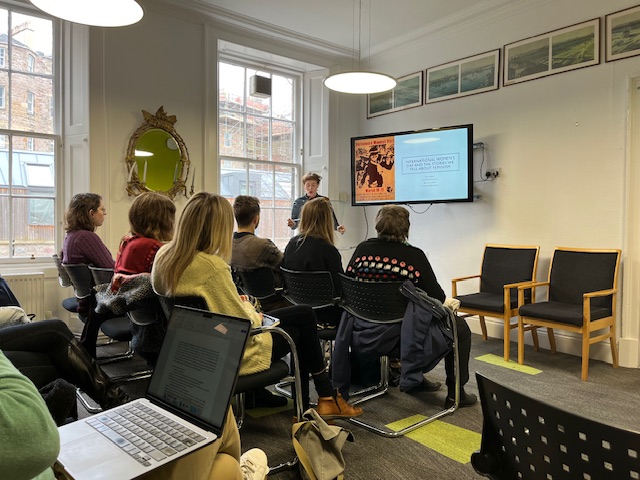
GENDER.ED and IASH partnered on several events marking International Women's Day and we began the day with our Inaugural Postdoctoral Fellow, Dr. Rosa Campbell, giving a paper titled "International Women's Day and the Stories We Tell About Feminism" at IASH. Here's an excerpt, based on this longer article, out in Signs.
Consciousness raising [CR] has been historicised as the distinctive tactic of women’s liberation, in both Australia, the US, the UK, across western Europe and in Scandinavia. It and involved at its peak, hundreds of thousands of women. CR took place in small groups often in the homes of women, or at women’s centres. During CR, which took place in small groups women shared their life experiences around particular topics or questions selected for discussion. Women’s experience of CR feature regularly in the archives and are often full of feeling. Working class feminist Zelda D’Aprano wrote that through consciousness raising ‘we were able to understand each other’s hearts and heads’ Another wrote in the periodical Womanspeak ‘Tuesday nights became like a drug supply and once a week I scored.’
The intellectual history of CR is usually attributed to the spread of Freudian psychoanalytic ideas after the Second World War, and therapeutic currents are certainly present in Australian movement material. However, to locate the history of consciousness raising solely in psychoanalysis would be to elide Maoist currents that informed this tactic and so fail to consider the impact of southern politics on the global north. Historians Quinn Slobodian and Christina Van Houten’s argument, that CR developed from the Maoist tactic of ‘speaking bitterness, can usefully shed light on practices in Australia. This tactic was adopted by the Chinese Communist Party during the land reforms of the 1940s and 1950s. As van Houton’s work considers, traces of Maoism can also be found in the work of the New York Red Stockings group, who were foundational to the development of CR in women’s liberation. In their guide to this technique The Red Stockings quote Mao directly but they are also reliant on China-watcher William Hinton’s book Fanshen, published in 1966. A poster featuring them reads ‘speak pains to recall pains’ which is taken from Hinton’s book.
It was through Fanshen that speaking bitterness entered the women’s movement. This was an account of a village transformed by the Communist revolution, indeed the title means ‘to turn over.’ In the US, it sold 200,000 copies in paperback and was widely translated. Through including Chinese women’s accounts of speaking bitterness, Fanshen was, according the Gail Hershatter, one of the first texts that considered Chinese women as more than ‘the beneficiaries or victims of state policy.’ Reflecting on the impact of Fanshen, Carol Hanisch said, ‘I’m sure when peasant women held their speak bitterness meetings…they never dreamed that their method of struggle would help inspire women half way round the world.’ Maoism, as translated through Fanshen, stressed that consciousness raising led to women taking collective action, a contribution psychoanalysis could not make.
Hinton’s influence can also be found in Australian women’s liberation. Melbourne feminist Karen Gillespie wrote, ‘Consciousness Raising, derives from the Chinese Revolutionary practice of ‘Speaking Pains to Recall Pains,’ a line taken from Fanshen. Gillespie quoted British feminist Juliet Mitchell’s Women’s Estate on the process of consciousness raising, and Mitchell herself relied on Fanshen. Mitchell explicitly pointed to the Chinese roots of the technique when she suggested that ‘consciousness raising is the reinterpretation of a Chinese revolutionary practice of speaking bitterness.’
To extend sightlines beyond consciousness raising, it is clear that Maoist China and post-war Vietnam offered Australian feminists a tantalising case-study in what women could achieve after their consciousness had been raised, but often Australian women misinterpreted Vietnamese and Chinese women’s action through their own vision of women’s liberation. Australian feminists who believed in organising without men emphasised East Asian women’s autonomous organising, particularly they highlighted Chinese women’s militancy and their collective engagement in heavy work that was traditionally men’s domain. Australian women were particularly captivated by ‘Gold Flower’s story’ from Jack Belden’s China Shakes the World, where women collectively physically confronted and beat up a violent man. Sydney feminist printing collective Words for Women described Gold Flower’s Story as ‘35 pages of one of the most inspiring stories we have ever read’ and quickly reprinted it as a pamphlet. ‘Gold Flower’s Story’, appealed to feminists across the board. For those inclined to socialism such as those in words for women, they appreciated it for how in their words, it showed that ‘the Communist Party of China…actually encouraged women to carry out resolute struggle against male oppression.’ But ‘Gold Flower’s Story’ would also have appealed to feminists who were at that moment developing an understanding of domestic violence and exploring collective solutions.