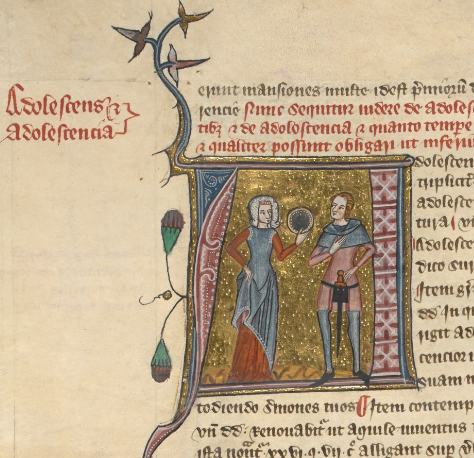
Adolesence in Medieval Europe
Affiliation
The historical study of adolescence is a relatively new field. Since the 1960s, medievalists have challenged the claim that a concept of adolescence emerged only in the eighteenth century, often turning to insights from other disciplines to help overturn many previous assumptions. This course explores both ideas and realties of adolescence in Europe between c.1000 and c.1300. By engaging with historical concepts such as life cycle, gender, masculinity, and identity, students will hone transferable skills in summarising and contextualising complex ideas and arguments. The course also supports students to compare evidence from a diverse range of primary sources and develop their written and oral communication skills. The first half of the course considers different challenges the historian faces when studying adolescence, including problems of definition, gendered assumptions, and the prejudices of source material. Medieval writers overwhelmingly presented adolescence as masculine, but many young women experienced a similarly liminal phase between childhood and adulthood. The second half of the module turns to tailored case studies across different settings to evaluate whether, and how, experiences of adolescence differed. Wider developments across the period touched the lives of young men and women in the form of increasing legal and social regulation and changes to rites of passage. Expanding urban environments, schools and universities drew groups of youths into ever closer contact, and often conflict. Many young people faced similar expectations and pressures even if their paths to adulthood were different within specific monastic, courtly, knightly, educational and working environments. But did all young people experience this distinct life cycle phase? And was there anything universal about adolescent experience in medieval Europe?
Credit Level: 10 Year taken: Year 3 Undergraduate SCQF Credits: 20
Not running in 2026/27
Entry type
CourseDRPS link
DRPSPhoto
Image