Celebrating a decade of our flagship course: welcome!
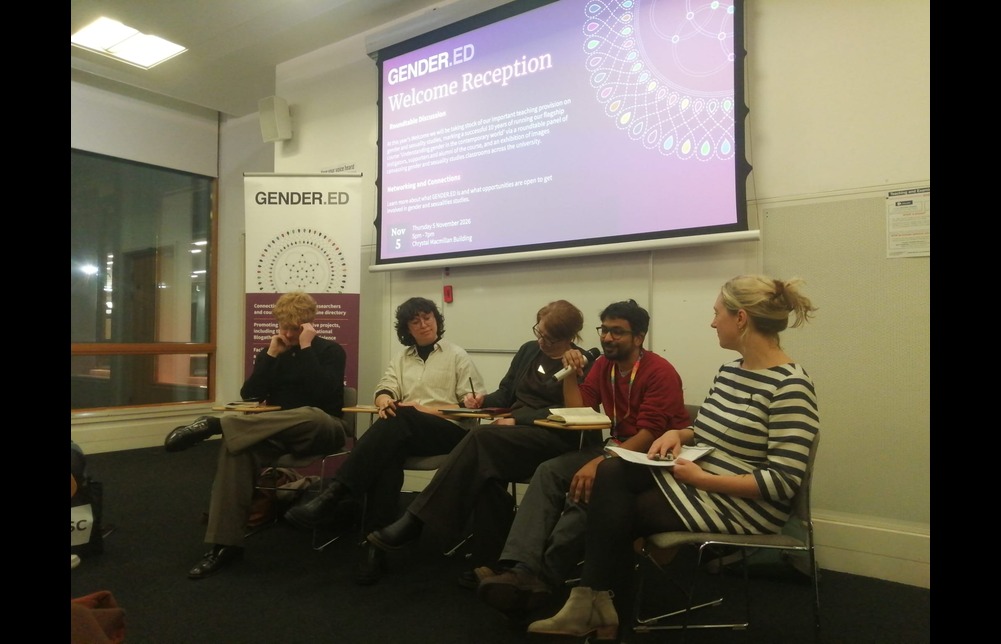
Roundtable panel on Understanding Gender in the Contemporary World. From left to right: Bradley Stevens, Victoria Amos, Meryl Kenny, Dash Sekhar and Becky Hewer. Photo by Kaveri Qureshi
Co-Director Kaveri Qureshi sums up GENDER.ED's annual welcome reception last week, drawing out key take-homes from the roundtable panel celebrating a decade of Understanding Gender in the Contemporary World, GENDER.ED's first flagship course, and our accompanying exhibition.
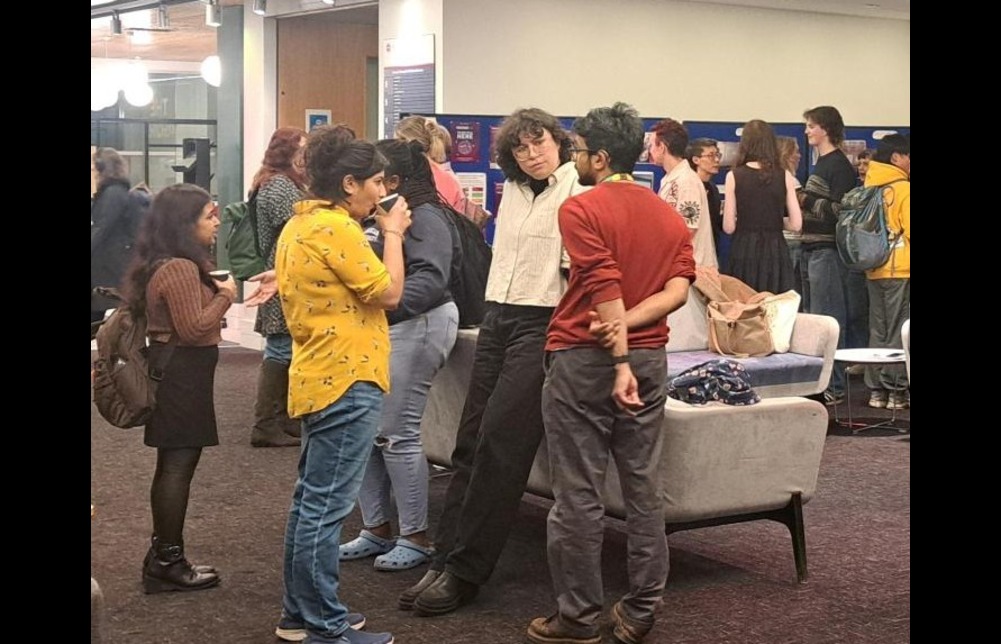
Last week GENDER.ED hosted our annual reception and roundtable discussion to kick off the academic year. In light of the industrial action that took place this semester, the event was postponed so drastically – Thursday of week 7! – that it was not really a welcome, but as Co-Director Becky Hewer said in her opening speech, we aspired to make the gender and sexuality studies community feel welcome.
Becky chaired a roundtable discussion featuring four panellists connected to our flagship course Understanding Gender in the Contemporary World, which has now been running for a successful decade. For us, this is huge! The course has a fascinating and inspiring history which is intimately connected with the start of GENDER.ED itself, as panellist Dash Sekhar explained. Dash described how, as the Education Officer for EUSA in 2014-15, he joined with other students agitating around sexual violence on university campuses and identified student demand for more extensive, and more widely accessible gender and sexuality studies teaching at Edinburgh. After mapping the academics with feminist research expertise across the University, Professor Fiona Mackay – now Professor Emerita, Politics and International Relations – stepped in and took on the mantle of building “something” up. It was amazing to hear that Dash had, at the time, envisaged the University establishing a Centre for Gender or possibly even a School for Gender! The GENDER.ED hub that you see before you, was the result instead.
Panellist Professor Meryl Kenny, Head of Politics and International Relations and Professor of Gender and Politics, picked up the story with how her she was initially hired by the University, as Lecturer in Social/Political Science (Gender), to take forward this agenda. Across 2015-26 Meryl put together Understanding Gender in the Contemporary World through a process of co-design with undergraduate students who were undertaking a credit-bearing course called Social and Political Science in Practice. She worked with 12 students to design content, assessments and get it through a Board of Studies. Meryl recalled how the EUSA VP Education sat for hours on end energetically passing on information about the new course at a time when there was no structure for advertising courses to students. As well as praising EUSA and the support extended to the course over the years by many Schools across the University, in what she called an ecosystem around the course, Meryl identified how central the tutors working on the course have been, over the years, to how the course developed. An external examiner commenting on the course called it not just a course but a prefigurative community.
Panellists Victoria Amos and Bradley Stevens spoke incredibly movingly, to the impact of this prefigurative community on students. Victoria was one of the 100 students in the first iteration of the course in 2016 and subsequently became one of those tutors who have contributed so much to the life and community around the course. Victoria remembered how mind-blowing the course was, as the first time she’d been pushed to do independent research and think through her own life via theory, as in the ‘gender observation’ assignment that continues till today. The attributed the course as the inspiration for her to focus her undergraduate dissertation on LGBT activism, and then undertake a PhD in Social Anthropology on queer Christians in the Philippines. Bradley, currently the President of EUSA, vividly captured how transformative the course was, not only for his academic career but also for his life. He said it gave him a sense that “there’s a path here that I want to follow” and “lit a fire in terms of the future courses I chose”. Building on Meryl and Victoria’s contributions, Bradley stressed how the tutors as much as the lecturers made the teaching, recalling Cat Wayland as tutor telling the group “this isn’t a safe space, it’s a brave space and I will push back on you”.
The roundtable expressed so much joy, dampened only by contemplation of whether a course like this could have come into being in the more austere institutional context we find ourselves in now, at the University, whether that ecosystem of multiple Schools extending support, would have materialised. Panellists took stock of threats to the course in terms of reduction of Guaranteed Hours staff to tutor, ultimately pushing towards larger tutorial group sizes inimical to the closeness and radical intimacy demanded by the course’s pedagogic model. There was discussion too, of the ways in which UGCW is intended as an invitation to students to do exactly what Bradley did – spiral through to develop this passion and expertise year-on-year via discipline-specific electives, and how the context of strict enrolment thresholds can jeopardize the wider teaching provision in gender and sexuality studies which is so urgently needed.
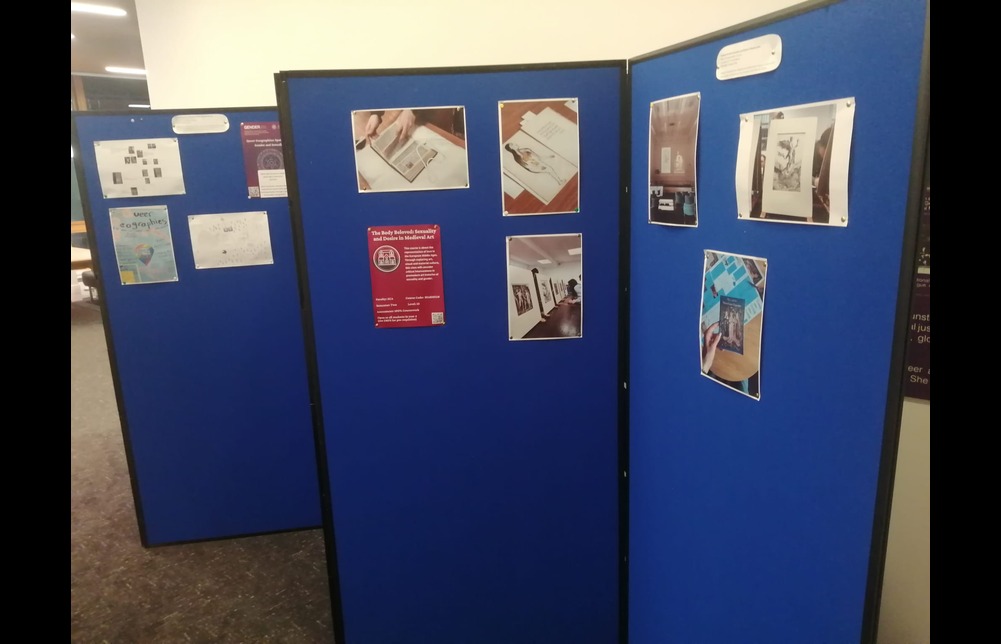
On exactly this issue, in the foyer we displayed an exhibition bringing together images made by our summer intern Jayni Makwana to publicize options courses in gender and sexuality studies from across the University among students and try to boost enrolment. Alongside, we showed a selection of photos illustrating class work undertaken, and student engagement on gender and sexuality studies courses, to convey a sense of the delight we at GENDER.ED felt to glimpse what happens in colleagues’ classrooms.
Huge thanks again, to Jayni for doing this work. Next week on the blog, we’ll open up a dossier of contributions celebrating Fiona Mackay, so please watch this space to hear more about Fiona’s contribution as Founding Director of GENDER.ED. Plus, later in the year we’ll have a dossier of blogs on feminist pedagogy, so watch out for that too!
For more on UGCW’s inception, check out the videos and content on our page here.