
Butch or Femme? A brief history of British 1960s lesbian subculture and gender stereotypes
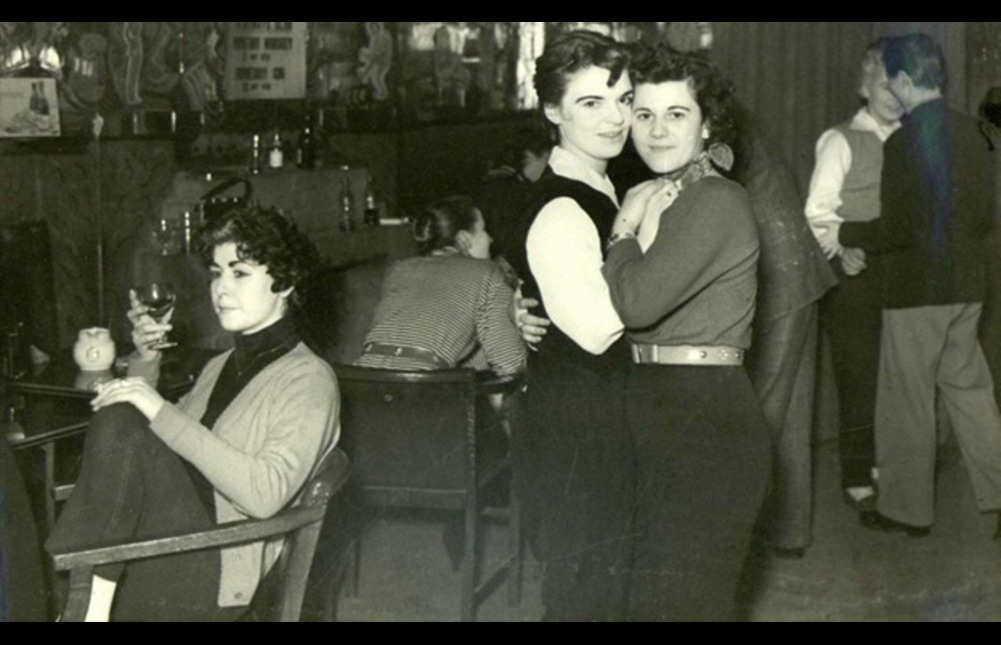
Image Caption: The Gateway's Club in Chelsea, London in the early 1950s.
Image credit: Richard Kessler, https://commons.wikimedia.org/wiki/File:Gateways-Club.jpg

For Pride Month, India Williams examines 1960s British lesbian subculture. In a time before pride parades and marriage equality, these lesbians were laying the foundation for queer culture as we know it today.
The 1960s were a revolutionary period for lesbian culture in the UK. From the first film featuring lesbian main characters, to nightlife to periodicals, the 60s saw the start of lesbian culture as we know it today. Outside of the lesbian space, the 60s were also a decade of change for women and class struggles, which often reflected onto the transformations that can be seen across sapphic culture.
During the 1960s, the percentage of women who were employed outside the home skyrocketed from 31% in 1961 to over 49% by the early 1970s as recorded by the British census (McCarthy 2017, 47). This change in employment now meant that some women were able to support themselves, and the need to marry and settle down was no longer a requirement for a comfortable life. As women gained more financial and legal independence, the stereotype of the butch-femme relationship also began to change, as femme-femme and butch-butch pairings arose. The Gateways Club on Kings Road in London became an arena for this debate, as some chose to maintain the dynamic, while others rejected it outright. The importance of this role-playing to some couples reflected the difficulty for women to find full-time, well-paying jobs that would allow them to support themselves without a man's salary:
The butchy types worked in garages or driving, and one was a watchmaker, hidden in the back of the shop. The femme ones tended to be housewives or secretaries: quite a lot were supported by their partners. They did cooking, housework, washing and ironing like a proper housewife. (Gardiner 2003, 52).
By the end of the 1960s, butch and femme identities had been driven out of the limelight, and with the 1970s’ emphasis on ‘coming out’ instead of blending in, couples that mimicked heterosexuality fell almost completely out of fashion (Jeffreys 1989, 158). Some scholars, such as Sheila Jeffreys, have blamed the Women's Liberation Front and the degradation of women’s gendered roles in heterosexual marriages to be the cause of this. Others, such as Joan Nestle – founder of the Lesbian Herstory Archive – claimed that the dynamic was never about heterosexual role-playing in the first place, and instead, it’s a historically contingent piece of lesbian culture that should not be forgotten (Jeffreys 1989, 171). This feeling of cultural importance was seen back in the 60s when the changes began, as many Gateways members did not want the new, young, and ‘open’ crowd to take over their space and traditions. For them, butch and femme were not merely about how you dressed, they were about how you gained respect and identified who was sexually available to whom, as well as creating distinction in a community of same-sex desire.
One group that mostly focused on femme and non-butch lesbians at the time was the Minority Research Group (MRG) and their monthly publication Arena Three (A3). The MRG was founded in 1963 by a group of five London lesbians from middle-class academic backgrounds. In 1964 they published the first edition of their periodical A3, encouraging readers to write in to the editor Esme Langley and stating the opinions/notes/letters would be published in following editions. This promise was upheld, and the conversations that ensued in the ‘notes to the editor’ section spanned a wide range of topics from the church and gay rights to new books, as well as some more controversial topics such as whether or not people dressed in ‘drag’, that’s to say men’s clothing, should be allowed to attend in-person social meetings held by the group (Jennings 2007, 162). Instead of putting effort into the up-and-coming pushes for gay rights, the MRG chose to focus their efforts on ostracising masculine-presenting lesbians, and stressing that lesbians should not act so outwardly queer, instead opting for feminine and ‘respectable’.
The 1968 Robert Aldrich film The Killing of Sister George took the lesbian world by storm, and not in a positive sense. The film's protagonist June, known as ‘George’, is a middle-aged, slightly masculine TV actress who has been written out of the soap opera she had been starring in. Meanwhile, her partner Alice, known as ‘Childie’, is younger and portrayed as innocent and childlike. While George is not presented as overly ‘butch’, she is shown getting drunk and smoking cigars, as well as verbally and physically abusing Childie. George’s male name, something that was common for butch lesbians, as well as her behaviour makes it clear that the director was attempting to portray her as a butch, and that she was taking advantage of the more innocent, fem(me)inine Childie. This film paints the couple as an imitation of a heterosexual one, with the strong, aggressive male breadwinner and soft, docile female who spends her days at home doting around, aligning with Jeffery’s ideas of what butch-femme means. When it was released in 1968/9, the film was met with a lot of confusion and discontent from the lesbian community. Although it was the first Hollywood film to feature lesbians as main characters, many felt that it played into the fetishisation of lesbians through the male gaze. One woman described the film by saying, “we probably did want a more positive image…The main characters were not like any lesbians we had ever met” (Gardiner 2003, 152).
Author bio:
India Williams is a third-year HCA visiting student from The University of British Columbia. Her research interests include 19th and 20th century queer history and archives. She is currently working on a photography project highlighting queer relationships and identity.
References:
Gardiner, Jill. From the Closet to the Screen: Women and the Gateways Club, 1945-85. Pandora Press, 2003.
Jeffreys, Sheila. “Butch and Femme: Now and Then.” In Not a Passing Phase: Reclaiming Lesbians in History; 1840 - 1985, 1st ed., edited by Lesbian History Group. Women’s Press, 1989.
Jennings, Rebecca. Tomboys and Bachelor Girls: A Lesbian History of Post-War Britain 1945-71. Manchester University Press, 2007.
McCarthy, Helen. “Women, Marriage and Paid Work in Post-War Britain.” Women’ s History Review 26, no. 1 (2017): 46–61. https://doi.org/10.1080/09612025.2015.1123023.