
Building feminist institutions and building feminist institutionalism
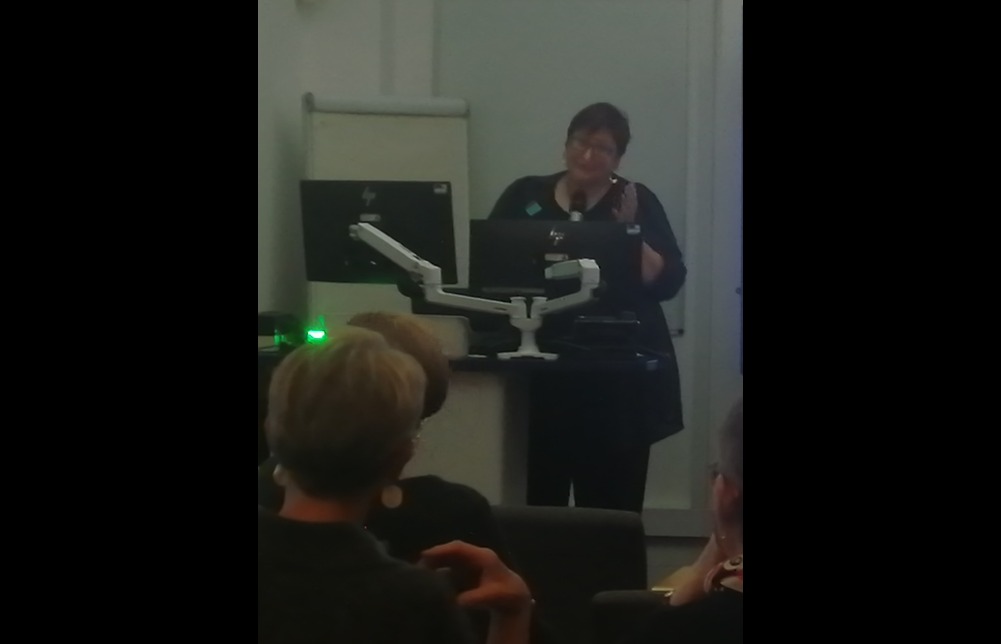
Fiona Mackay offering concluding comments. Photo by Kaveri Qureshi
GENDER.ED reports on a roundtable on feminist institutionalism, convened on the occasion of Fiona Mackay's retirement, which addressed some of the most urgent questions of our times.
To mark Professor Fiona Mackay’s wide-ranging and path-breaking contributions to feminist institutionalism, a panel of research collaborators convened to take stock of the question, as posed by Fiona, “does feminist institutionalism have a future?”.
The discussion drew together world-leading experts from academia, governments, and international bodies: Annika Bergman Rosamond (Edinburgh), Louise Chappell (UNSW Sydney), Toni Haastrup (Manchester), Cecilia Josefsson (Uppsala), Mona Lena Krook (Rutgers), Angela O’Hagan (Glasgow Caledonian University), Michelle Rouse (Ulster), Yvonne Strachan (formerly Scottish Government), Tania Verge (Universitat Pompeu Fabre/Government of Catalonia) and Georgina Waylen (Manchester).
Contributors spoke to how feminist principles can be embedded within political institutions in today's climate of democratic backsliding and anti-gender movements. They emphasised significant gains in altering the formal and informal rules of institutions, but also warned that the endurance of these gains requires constant vigilance against bureaucratic resistance and political hostility.
Tania Verge, reflecting on her time as the first Minister of Equality and Feminisms of the Government of Catalonia, spoke of the potential of "feminist insiders" to transform state mechanisms. She described how her team successfully displaced or complemented existing formal rules with new documents and informal practices, thereby changing what the state symbolically represents. By engaging across ministries and creating participatory spaces for civil society, the Catalan Government demonstrated that feminist actors could effectively bring diverse stakeholders into the fold of gender mainstreaming. However, the fragility of progress was a recurring theme. Louise Chappell's analysis of the International Criminal Court revealed that high levels of female representation are not guaranteed to persist. After initially achieving sixty percent women on the bench, the ICC saw this figure drop to thirty percent, compounded by a leadership crisis involving sexual harassment allegations against the Chief Prosecutor. Chappell emphasized that rules only matter when instantiated in practice. “The first Chief Prosecutor didn’t care about gender justice, yet the second made it her number one priority. Working with the same set of rules, she challenged gendered logics of appropriateness and the gendered legacies of the first iteration of the Court”. Chappell noted that crises can also catalyse important institution-building, as with the push to recognize gender apartheid as a crime against humanity.
The nature of resistance was further explored by Cecilia Josefsson and Michelle Rouse, who argued that opposition to feminist goals has shifted from being socially unacceptable to being politically rewarded. Josefsson warned that resistance often appears ordinary, manifesting as bureaucratic delays where bills are sent for review until forgotten. She provocated that resistance is actually a signal that feminist ideas are successfully challenging power structures, necessitating a shift in focus from how institutions change to how they endure. Michelle Rouse added that modest improvements in outcomes for women over the last two decades suggest a need to look beyond elite bureaucrats to the core executive, where discretion allows for the de-prioritization of gender justice. She called for recalibrating theories of representative democracy to focus on substantive representation rather than mere presence, noting that old informal rules can corrode new institutions even as new norms attempt to rise.
In the face of these challenges, speakers proposed strategies for preservation and adaptation. Mona Lena Krook highlighted the necessity of archiving feminist knowledge, describing efforts to collate USAID documents on gender, as well as by other organisations whose websites were shut down during Donald Trump’s second term. “These are policies, reports, knowledge that were out there; we can save, archive it and then when the Democrats are voted back, they won't need to start from scratch”. Doing this work, she said “I feel like I've become part of the resistance!”. Annika Bergman Rosamond recognised that “documents disappear when governments change” and echoed how “more of us should make banks of feminist knowledge”. Annika also acknowledged the intersectional nature of crises, a theme taken up by Toni Haastrup and Georgina Waylen, who expanded the scope of the discussion to include colonial legacies and the rise of the radical right. They argued that feminist institutionalism must engage deeply with the global South and develop methods to study anti-gender actors who are explicitly opposed to feminist work. The erosion of democratic guardrails, particularly in the US under Trump, demands a robust feminist institutional analysis to understand how informal rules fail to constrain authoritarian tendencies.
Practical applications of these theories were shared by Yvonne Strachan and Angela O'Hagan regarding the Scottish Government. Strachan described "relentless proactiveness" as a key tactic, where equality must be kept visible through constant reporting and data analysis to prevent it from being ignored. O'Hagan reflected on gender budgeting, noting that while it offers a powerful tool for policy change, it remains vulnerable to legislative rollbacks. Both highlighted that maintaining momentum requires continuous effort and the collaboration of informal actors within new systems.
Concluding the event, Fiona Mackay affirmed that feminist institutionalism retains a vital future, serving as an intellectual home and a source of solidarity. “By doing this work, we can give tools to equip the campaigns going on around us. It is important to recognise the interplay between institutional actors, civil society and academics, because this is what will bring things forward”. She emphasized that the field must evolve to address pressing contemporary issues, including the paradox of defending neoliberal institutions that feminists once sought to overthrow. She provocated that ultimately, while feminist institutionalism will endure, it must constantly re-evaluate its relevance, deepen its commitment to intersectionality, and remain alert to the urgent struggles of the current moment to ensure that hard-won gains are not lost.