
Book Launch: Playwriting and the Craft of Audience Participation
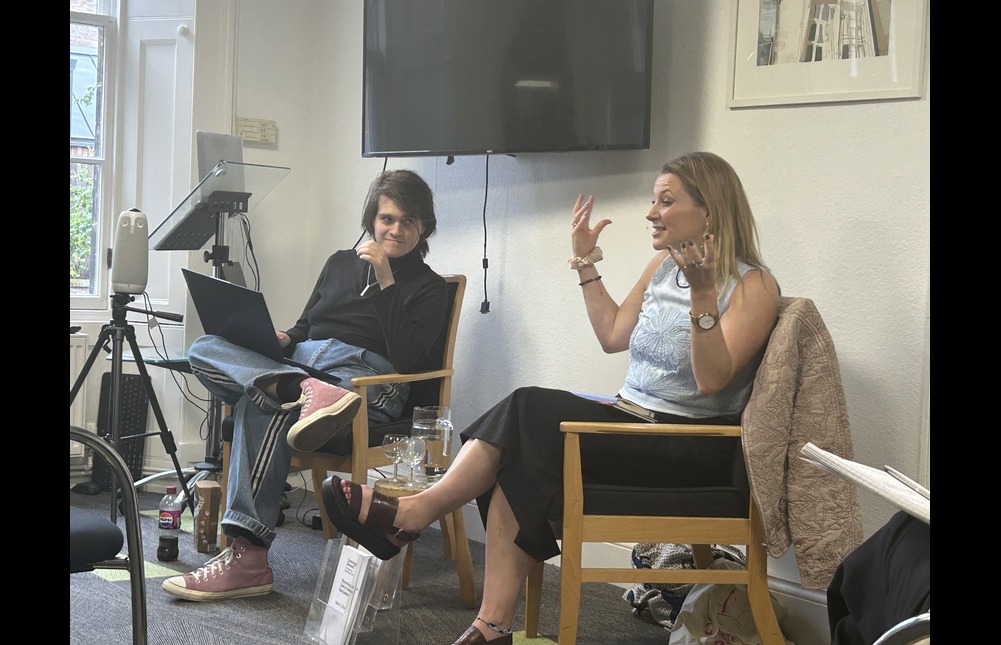
Dr Helen Shutt in conversation with Jack MacGregor. Image credit: Jayni Makwana.
Last week, the Institute for Advanced Studies in the Humanities hosted a launch for GENDER.ED-IASH Postdoctoral Fellow Dr Helen Shutt’s new book Playwriting and the Craft of Audience Participation (Cambridge University Press, 2026). The conversation, chaired by IASH’s award-winning resident playwright Jack MacGregor, was about how writers can craft opportunities for audience participation in performance through a care-centred approach.
Helen’s inspiration for this project stemmed from her experience working as an usher at the Royal Court Theatre, which raised her awareness of the exciting impact of breaking the fourth wall, as the audience felt like they had a unique experience of the performance. She discussed the importance of community, describing participation and co-creation as a valuable mechanism by which audience members can recognise their shared experiences, particularly in the case of plays that explore darker themes such as Duncan Macmillan and Jonny Donahoe’s Every Brilliant Thing. She also cited Tim Crouch’s My Arm and Nassim Soleimanpour’s White Rabbit, Red Rabbit as examples of impactful audience participation.
Helen noted that audience participation can be underwhelming, or even traumatising. Against these challenges, her framework focuses on how practitioners can facilitate audience participation in a way that is care-centred. She explained how care should not only guide the process of creating work, but the craft of playwriting itself, for example, through the playwright’s language, or the way in which characters interact with the audience. She discussed Chris Thorpe and Hannah Jane Walker’s play The Oh Fuck Moment, where audience members are encouraged to share their own “fuck ups”, but managing audience disclosures caringly and giving them time to consider what they would be willing to share.
There is sometimes an assumption that playwrights are not central in creating collaborative or devised work, but Helen argued that, that if done well, it is actually harder for the playwright to craft successful participatory work than pieces with no participation at all. She highlighted how the responsibility of the play still lies with creators during this kind of theatre, as they foster the environment and craft the rules for participation.
The conversation then moved onto the key takeaways that Helen would like practitioners to gain from the book. Helen seeks to make tangible the strategies of care that playwrights can employ when considering audience participation. She also anticipated the use of this work beyond theatre participation, thinking more generally about how care crafts relationships. As a teacher, she also recognises how these principles can be applied to classroom settings.
The Q&A was lively. Helen was asked about her doctoral thesis, in response to which we learnt that Helen wrote two plays during her PhD! Ine for children and one for adults, Being with Raven. Both relied on audience participation; making them instructive experiences for crafting Helen’s inclusive framework. Helen was pushed to speak to the theoretical distinction and connection between “internal” participation, where the audience subconsciously participates in theatre through meaning-making, and “externalised” participation, where the audience may be invited to actively and consciously take part in the show. She explained that audience members often become aware of their internal participation when other audience members engage in external participation, as they reflect on how others' interpretations, thoughts and ideas relate to their own.
Questions then moved to more practical considerations. Helen highlighted that “the art of facilitation is needing to couple anticipation with adaptation”, and playwrights must comprehend how participation will work if there are thirty members of the audience, or if there are three. She also acknowledged that a flat refusal from the audience to participate can be absorbed into the drama. Helen explained that playwrights might be surprised by the opportunities that arise from giving prompts to the audience, and that they can use language to inspire the audience to participate, as she did through poetry and alliteration in Being with Raven.
Helen’s work can serve as an inspiration for both theatre practitioners and indeed, all those who want to adopt care-centred approaches into their work.