
GENDER.ED - EUSA Undergraduate Feminist Trailblazer Awards: 2nd Prize
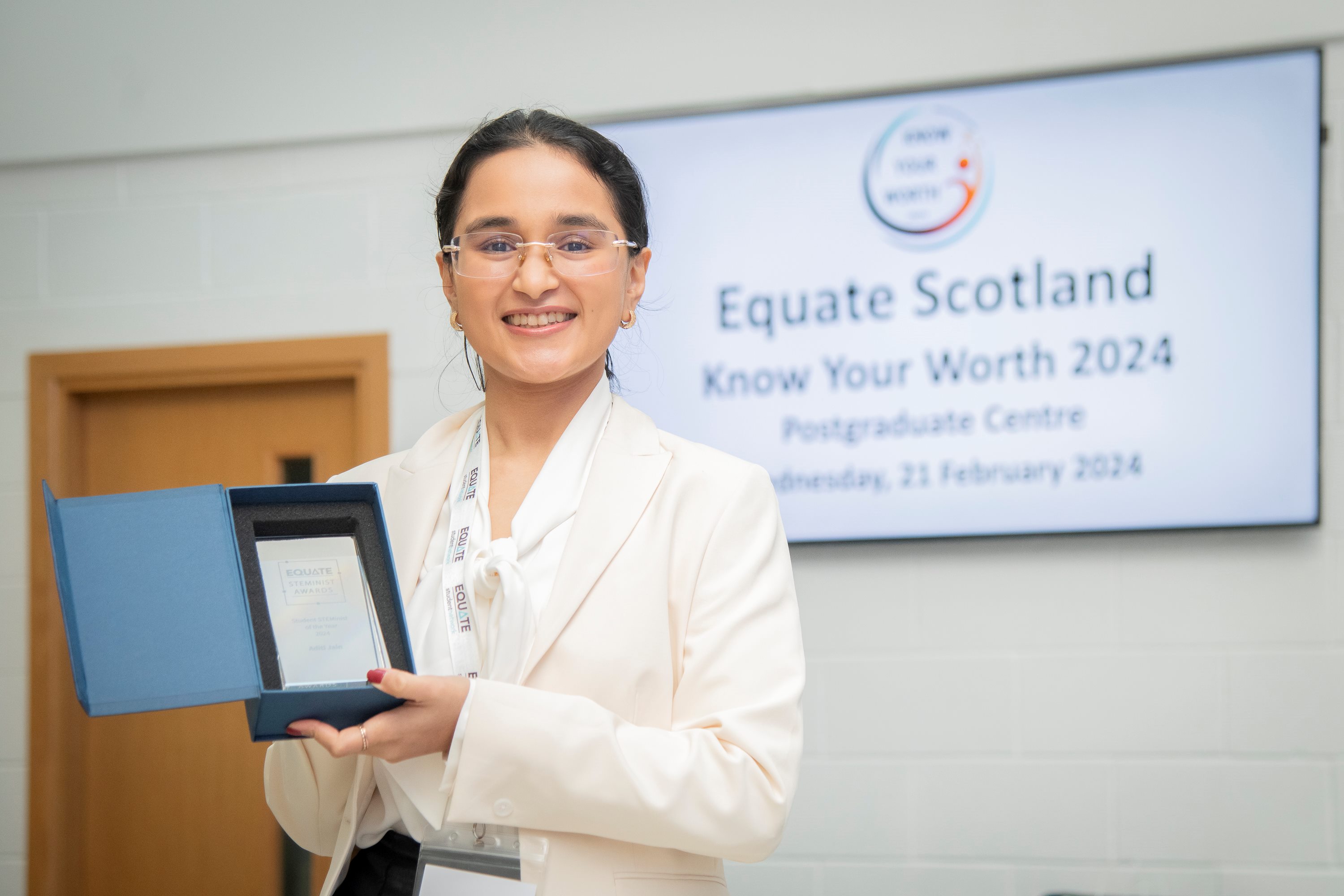
Aditi Jain, 2024 Feminist Trailblazer Award 2nd Prize Winner .
Credit: Equate Scotland
2024 marks the third year of the GENDER.ED-EUSA Undergraduate Feminist Trailblazer Awards. The awards seek to recognise extraordinary commitments to feminist scholarship and change on campus. The winner of 2024’s GENDER.ED-EUSA Undergraduate Feminist Trailblazer Award 2nd Prize is Aditi Jain, who recently graduated with a BSc (Hons) in Pharmacology. We asked Aditi to share some of her thoughts on feminist work and what motivates her.
What does feminism mean to you?
Feminism, to me, is about creating equal opportunities and dismantling systemic barriers that have historically marginalized women and other underrepresented groups. It's not just about advocating for women's rights but ensuring that all individuals, regardless of gender, have the same opportunities to succeed and thrive. It's about fostering inclusivity and equity in all spheres of life, particularly in fields like STEM where women are often underrepresented.
What motivates your feminist work?
Coming from a developing nation, I have witnessed the deeply ingrained inequality women face from a young age. My motivation didn't arise from reading about inequality in papers or seeing it on the news; it came from observing my own surroundings. As I grew older, I realized that while the world was changing, people's mentality and respect toward women were not. This awareness fuelled my passion for promoting women's rights.
My specific interest in women in STEM began when I saw women in my country facing health issues and receiving inadequate help. This motivated me to pursue a degree in pharmacology, recognizing the need to promote women's health and bridge the gender gap in medical research. At university, I discovered that this issue was not confined to my country but was a global problem. Seeing women in various STEM fields face similar challenges further fuelled my passion.
Often, women are told that careers in STEM fields are "not our cup of tea." I always questioned why. There are countless examples of talented and hardworking women who have made significant contributions to advancing knowledge in these fields. We need to highlight these achievements and support the women currently in STEM while also inspiring the younger generation. By being role models, we can encourage them to be brave and pursue their passions without hesitation.
Who else do you consider a ‘Feminist Trailblazer’?
For me, being a feminist trailblazer is not just about looking up to individuals who have made a significant impact on a large scale but also recognizing those who create change at a smaller, more personal level. Every individual who has the courage to stand up for themselves and those around them—in whatever capacity—is a trailblazer.
I draw inspiration from my peers in the Women in STEM Society. These women work tirelessly to support and uplift each other, creating a more inclusive community. Their efforts in mentoring, promoting inclusivity, and organizing educational sessions are remarkable examples of feminist trailblazing.
Overall, it is everyday acts of courage and advocacy, whether in a small village or a large institution, that contribute to the feminist movement. It is this collective effort that drives progress and inspires me to continue my work in promoting gender equality.
In your opinion, what does a feminist utopia have that our current society is lacking?
A feminist utopia, in my view, is a society where equity is the norm, and diversity is celebrated in every aspect of life. This utopia would have structures and policies in place that ensure equal access to opportunities, resources, and support for all individuals, regardless of gender. It would be a place where reproductive rights are guaranteed, and women are free from violence and discrimination. Furthermore, this society would prioritize the inclusion of marginalized voices in decision-making processes, ensuring that all perspectives are represented and valued. Our current society often lacks these elements, and achieving a feminist utopia would mean addressing and dismantling these systemic inequities.